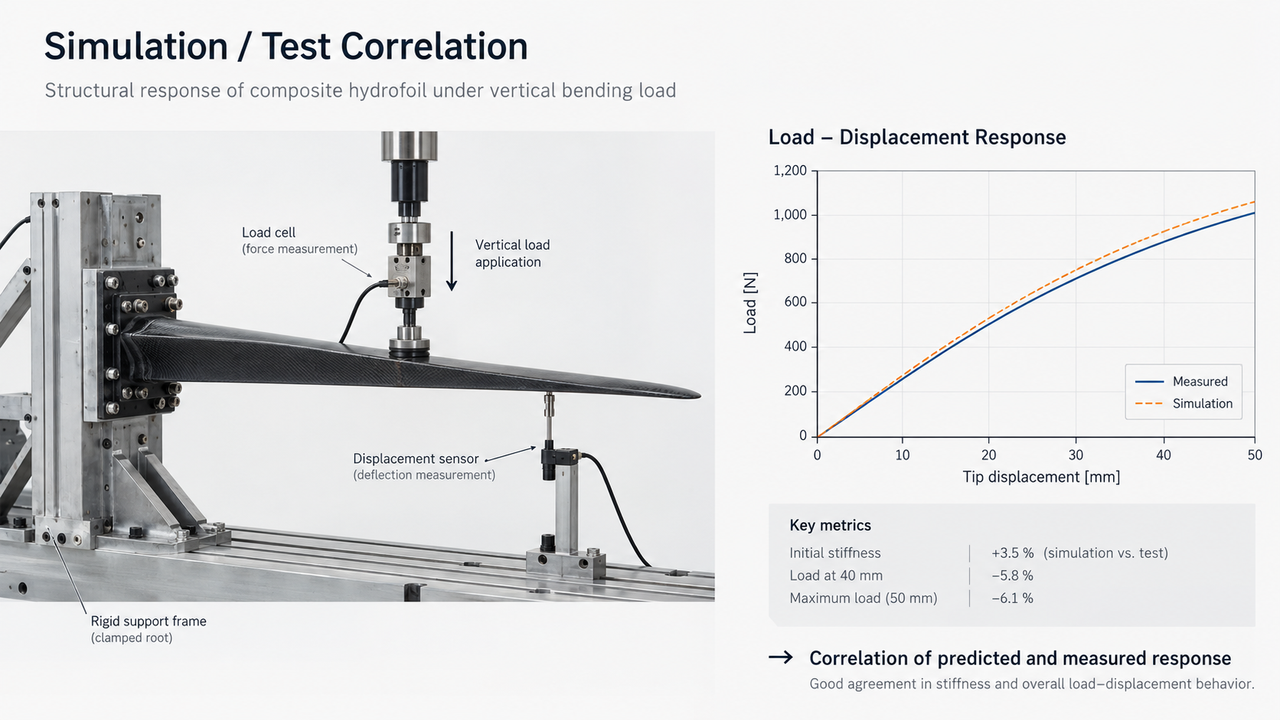
Prediction versus measurement
Simulation and physical measurements showed a large discrepancy in hydrofoil deflection.
The objective was to understand the source of the error, improve the prediction method and determine whether the available data supported a reliable structural safety-factor estimate.
What I did
- Reconstructed the calculation chain behind the predicted deflection.
- Improved the internal physics-based deflection method.
- Compared the revised prediction with physical measurements.
- Investigated uncertainty in geometry, material properties, applied loads, boundary conditions and measurements.
- Identified the additional inputs required for a reliable safety-factor estimate.
Physical evidence
The study combined structural testing with physical load and deflection measurements, strain gauges and data acquisition.
The comparison between predicted and measured behaviour was used to distinguish modelling limitations from uncertainty in the available inputs.
Engineering conclusion
What improved
The revised method substantially improved agreement between predicted and measured deflection.
What remained unresolved
The available measurements were insufficient to determine a precise structural safety factor.
The study identified the geometry, material, load, boundary-condition and measurement data that required better characterisation before calculating one.