The challenge
EPFL Solar Boat was developing a full-scale composite hydrofoil boat from detailed design through manufacturing.
I was responsible for assessing the structure as a complete system and helping define laminate designs before production.
What I did
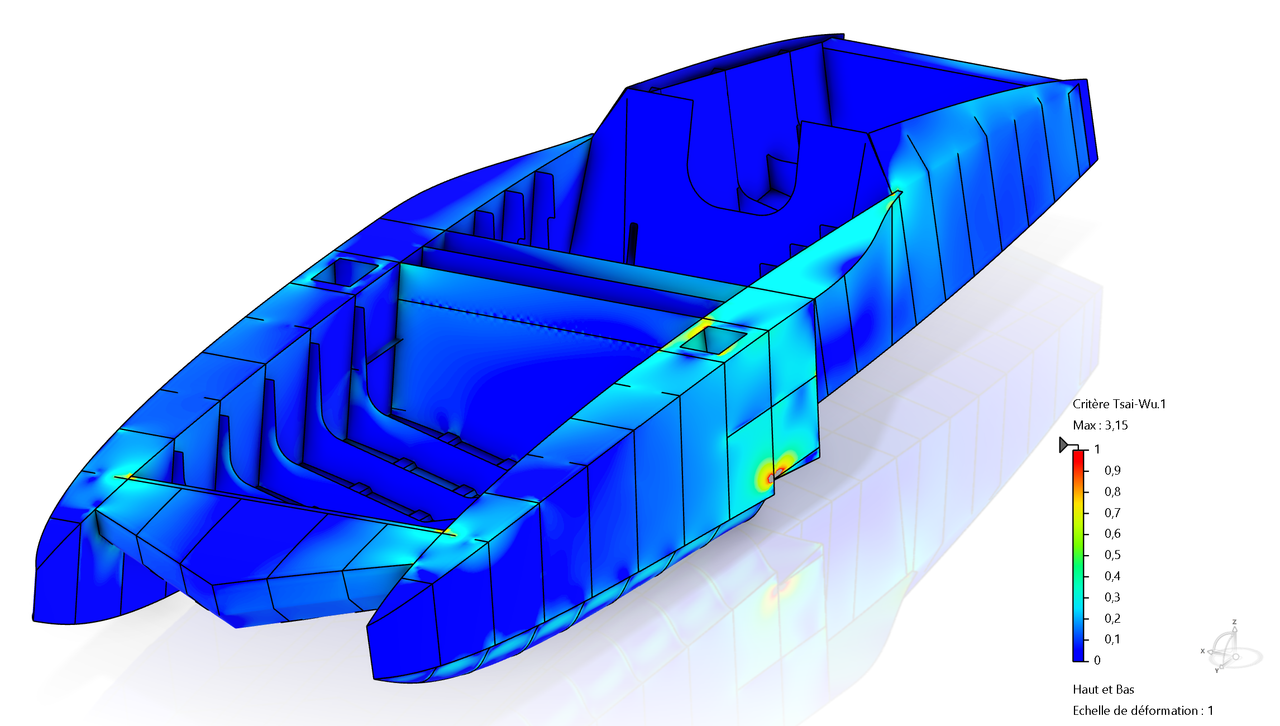
- Built and maintained a full-vessel composite model covering the hull, internal structure, floats, foil wells and appendages.
- Defined laminate zones and stacking sequences.
- Assessed planing, flight, crash, slamming and immersion load cases.
- Evaluated composite failure using Tsai-Wu criteria.
- Checked mesh convergence and investigated local numerical singularities.
- Iterated laminate and structural designs with the team before manufacturing.
Analysis approach
The model was used to evaluate global stiffness, load transfer and composite margins across the complete vessel rather than analysing isolated components independently.
Local reinforcement, laminate definition and structural interfaces were updated as the design evolved.
Simulation vs physical testing
Four-point bending tests provided a direct comparison between simulation and physical measurements on two documented configurations.
| Configuration | Measured | FEA | Difference |
|---|---|---|---|
| Configuration 1 | 20.0 mm | 18.8 mm | 6.0% |
| Configuration 2 | 0.90 mm | 0.92 mm | 2.2% |
Outcome
The resulting laminate and structural design progressed to manufacturing by EPFL Solar Boat and NTPT.